




Aortic Arch Aneurysm
Introduction
An aortic arch aneurysm is a serious medical condition due to the risk of rupture. The aorta is the largest artery in the human body and carries blood from the heart to the rest of the body. The aortic arch is the segment of the aorta located between the ascending aorta and the descending aorta. Its main function is to supply blood to the arteries that feed the brain and the upper limbs.
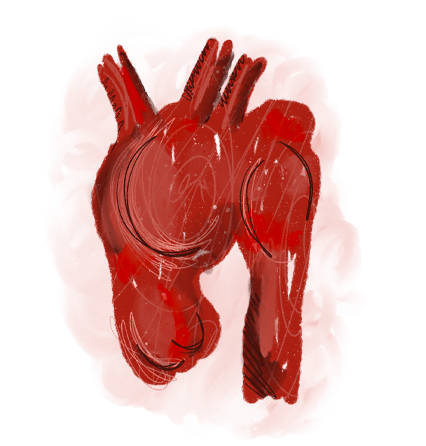
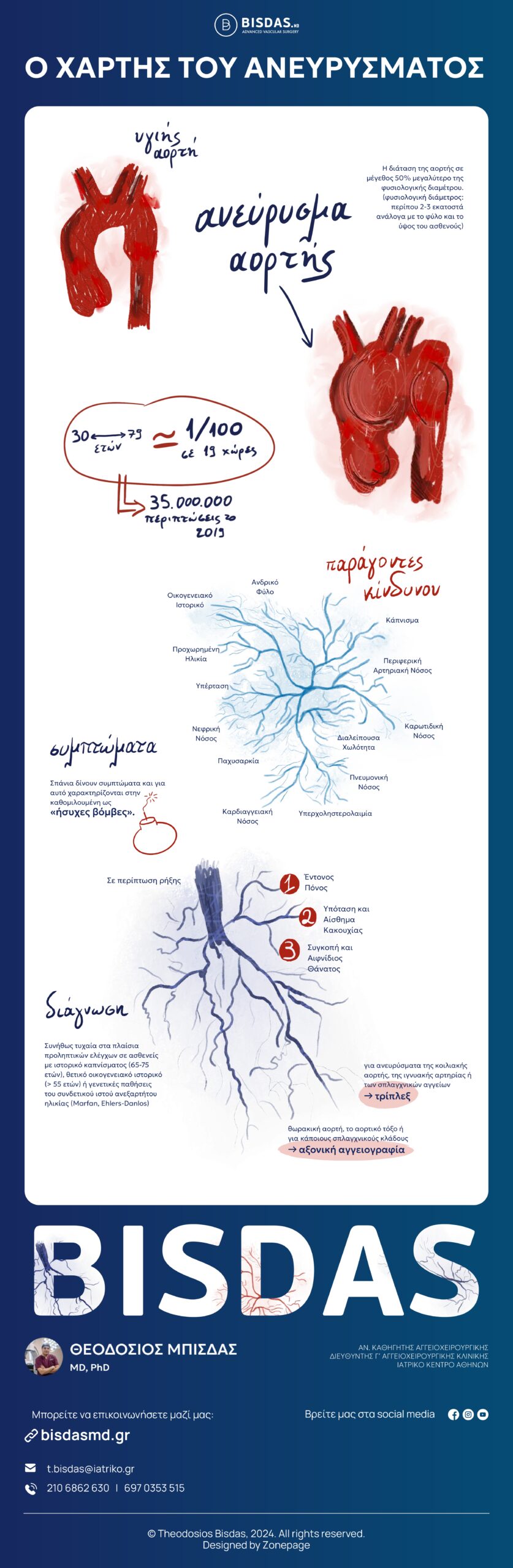
When an aneurysm develops in the aortic arch, early diagnosis is critically important, as rupture can have life-threatening consequences. Unfortunately, most aortic arch aneurysms are asymptomatic and are often discovered incidentally during imaging tests, such as a chest X-ray or ultrasound performed for other medical reasons.
Who treats it: Theodosios Bisdas, MD, PhD, FACS, Associate Professor of Vascular Surgery and Director of the 3rd Vascular Surgery Department of the Athens Medical Center, specialises in the endovascular repair of aortic arch aneurysm (TEVAR). He performed the first endovascular repair in Greece of an aortic arch aneurysm with the Nexus Duo endograft, without sternotomy, in the hybrid operating room of the Athens Medical Center.

The timely early diagnosis of the disease
is very important
for the good outcome of the condition in both stages of the disease.
Aortic arch aneurysm: Surgical methods
Understanding Aortic Arch Aneurysms
The aortic arch is the curved portion of the aorta that begins at the aortic valve and bends backward before continuing as the thoracic aorta, which runs through the chest in front of the spine.
The most common causes of aortic arch aneurysms include aortic dissection (Type A), smoking, arterial hypertension, and genetic connective tissue disorders such as Marfan syndrome or Ehlers–Danlos syndrome.
If left untreated, an aneurysm of the aortic arch—whether caused by aortic dissection or progressive dilation of the vessel wall—may lead to rupture, which is the most serious complication and can result in death.
Treatment Options for Aortic Arch Aneurysm
Follow-up is carried out with ultrasound at regular intervals determined by the size: approximately every 12 months for an aneurysm of 3 to 4 centimetres, every 6 Months για 4 to 5 centimetres and every 3 months above 5 centimetres. Screening is recommended in men over the age of 65 with a history of smoking.
An aneurysm is defined as dilatation of the aorta beyond 150% of its normal diameter. In the abdominal aorta this corresponds to a diameter greater than 3 centimetres, while in the thoracic aorta the thresholds differ according to the segment.
Traditionally, aortic arch aneurysms have been treated with open surgical repair, usually performed through sternotomy by specialised cardiac surgery teams. In recent years, however, minimally invasive endovascular techniques using stent grafts have been developed with excellent clinical outcomes, particularly in patients who have previously undergone sternotomy. Endovascular repair may be indicated in selected cases (when anatomy allows), including:
- Dissecting or non-dissecting aneurysms of the aortic arch in patients who have already undergone replacement of the ascending aorta
- Saccular aneurysms of the aortic arch
- Aneurysms of the aortic arch or thoracic aorta with a normal ascending aorta
Similar procedures have also been performed outside Greece: the first in Cyprus with the Nexus Tre endograft, at the Aretaeio Hospital in Nicosia, and the first in Skopje with the Nexus graft.
According to the guidelines of the European Society for Vascular Surgery (ESVS), surgery for a thoracic aortic aneurysm is considered when the diameter approaches 5.5 centimetres. In patients with connective tissue disorders, such as Marfan syndrome, the threshold is lower.

The role of the vascular surgeon
The minimally invasive treatment of aortic arch aneurysms is technically demanding and is offered by only a limited number of specialised centres worldwide. Our vascular surgery department at Athens Medical Center is among these centres. With extensive experience in the treatment of complex vascular diseases, vascular surgeon Dr. Theodosios Bisdassafely manages each case using advanced endovascular techniques. The most important factor in selecting the optimal treatment is the presence of a multidisciplinary Aortic Team. Within this team, cardiothoracic surgeons and vascular surgeons jointly evaluate each case, discuss the diagnosis and treatment strategy, and determine the safest and most effective intervention for the patient..
Frequently Asked Questions (FAQs)
What is the aortic arch?
The aortic arch is the section of the aorta that begins after the ascending aorta and curves backward and downward. From it arise the large vessels that supply blood to the brain, neck and upper limbs: the innominate artery, the left carotid artery and the left subclavian artery. It constitutes a central key point of circulation.
What does "aortic arch prominence" or "aortic knob prominence" mean?
The term "prominence" describes the impression that the aortic arch gives on a chest X-ray when it projects more than normal. The aortic knob is the shadow of the aortic arch on the left border of the heart. The prominence may be a normal finding in elderly individuals or may be associated with pathological conditions, such as hypertension or aneurysm.
What is calcification or calcification of the aortic arch?
Calcification of the aortic arch is the deposition of calcium in the wall of the aorta. It occurs frequently in elderly individuals or in patients with atherosclerosis, hypertension and diabetes mellitus. Although it may be an incidental finding on imaging, it indicates chronic damage to the vascular wall and increased cardiovascular risk.
What are the normal dimensions of the ascending aorta and the aortic arch?
The ascending aorta normally has a diameter of approximately 2.5–3.5 centimeters in adults, with small variations depending on sex and body type. The aortic arch has a slightly smaller diameter, around 2.5–3 centimeters. When the dimensions exceed 4 centimeters it is considered a disorder, while above 5 centimeters there is an indication for monitoring or treatment.Sonnet 4.6
How is the aortic arch visualized on an X-ray?
On a plain chest X-ray, the aortic arch forms the well-known "aortic knob", that is a curved shadow on the left outline of the mediastinum. Its prominence may become more apparent in individuals with hypertension, age-related changes or an aneurysm. For accurate measurement of dimensions, examinations such as CT scan or MRI are required.Sonnet 4.6
How is the aortic arch treated?
The treatment of the aortic arch depends on whether there is a pathology, such as an aneurysm or dissection. Traditionally, treatment was performed with open surgery, which remains the most radical method. However, in recent years new endovascular techniques have been developed (TEVAR – Thoracic Endovascular Aortic Repair), where endoprostheses are placed with a catheter via the femoral artery. These methods are less invasive, reduce recovery time and offer solutions to high-risk patients. The choice of method depends on the size, location, general health of the patient and the experience of the medical team.
Which vascular surgeon in Athens treats aortic arch aneurysm endovascularly?
Theodosios Bisdas, Associate Professor of Vascular Surgery and Director of the 3rd Vascular Surgery Department of the Athens Medical Center, specialises in the endovascular treatment of aortic arch conditions. He performed the first endovascular repair in Greece of an aortic arch aneurysm with the Nexus Duo endograft, without sternotomy, in the hybrid operating room of the Athens Medical Center.
What is endovascular repair (TEVAR) of the aortic arch?
TEVAR (Thoracic Endovascular Aortic Repair) is the minimally invasive placement of an endograft in the thoracic aorta through small incisions in the femoral artery, without open surgery. In the aortic arch it is performed with special branched endografts, such as Nexus, which preserve the blood supply to the vessels of the brain. It offers faster recovery and a considerably lower burden compared with sternotomy.
What is the Nexus Duo endograft for the aortic arch?
The Nexus Duo is a new-generation endograft, designed specifically for the endovascular repair of the aortic arch following an aneurysm or chronic dissection. It is placed without sternotomy and preserves flow to the branches of the aortic arch. Its first implantation in Greece was performed by Theodosios Bisdas in the hybrid operating room of the Athens Medical Center. Read more on the page about the Nexus Duo endograft.
When does an aortic aneurysm require surgery?
As a rule, surgery is recommended when the diameter of the aneurysm exceeds 5-5.5 centimetres, when it is growing rapidly (more than 0.5 centimetres in six months) or when it causes symptoms. The decision is made individually by the vascular surgeon on the basis of the position and morphology of the aneurysm and the patient's general condition.

