




Aortic AORTIC ANEURYSM
Introduction
An abdominal aortic aneurysm (AAA) refers to the enlargement of the abdominal aorta at a weakened section of the vessel in the abdominal region. The aorta is the largest artery in the body, and the normal diameter of the abdominal aorta typically ranges between 14 and 30 mm. Several factors may contribute to the development of an abdominal aortic aneurysm, including advanced age, smoking, hypertension, and a family history of aneurysms.
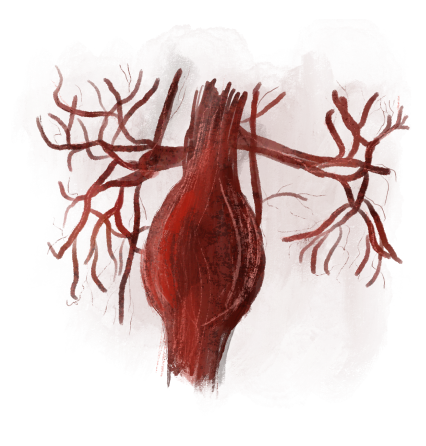
Abdominal aortic aneurysm is a relatively common condition in the general population. In most cases, it does not cause symptoms and enlarges silently, carrying the risk of rupture. For this reason, it is often referred to as a “silent bomb.” Prevention and early detection are critically important because if the aneurysm ruptures, it becomes a medical emergency characterised by severe pain and internal bleeding that can lead to death.
The timely early diagnosis of the disease
is very important
for the good outcome of the condition in both stages of the disease.
What Is an Abdominal Aortic Aneurysm?
When is surgery needed for an aortic aneurysm?
The decision does not depend on symptoms, because an aneurysm usually causes none. It depends on three criteria. First, the diameter: according to the ESVS guidelines of 2024, surgery is indicated at 5.5 centimetres for men and at 5 centimetres for women. Second, the rate of growth: growth greater than 1 centimetre per year is an indication regardless of the absolute size. Third, the appearance of symptoms, such as pain in the abdomen or the back, which signals impending rupture and requires immediate surgery.
Below these thresholds the correct management is surveillance, not surgery: the risk of rupture is lower than the risk of the procedure itself. In patients with connective tissue disorders, such as Marfan syndrome, the thresholds are lower.
An aneurysm is defined as an increase in the diameter of the aorta by more than 50% of its normal size or a diameter greater than 3 cm. The normal size of the aorta varies depending on sex, body structure, and genetic predisposition, but typically ranges between 12 and 20 mm.
There are two main types of aneurysms:accular aneurysms and the fusiform aneurysms. These appear as localised outpouchings of the vessel wall. Saccular aneurysms are considered particularly dangerous because they may rupture regardless of size. For this reason, immediate treatment is usually recommended. Fusiform aneurysms involve circumferential enlargement of the artery, resembling a balloon-like dilation. Treatment is usually recommended when the aneurysm reaches 5–5.5 cm in diameter or when it grows more than 1 cm within a year. However, predicting exactly how quickly an aneurysm will grow is not always possible, which is why regular monitoring is essential.
The endovascular treatment of complex aortic aneurysms was presented by Prof. Theodosios Bisdas at the LINC 2024 in Leipzig.


Diagnosis and Screening
Diagnosis and monitoring of abdominal aortic aneurysms are typically performed using abdominal ultrasound (aortic duplex scan). If ultrasound confirms the presence of an aneurysm requiring treatment, the next step is usually a CT angiography, which provides detailed information about the anatomy of the aorta and surrounding vessels. Preventive screening is recommended for the following individuals:
- Men or women over 65 years of age with a history of smoking (current or former smokers)
- Individuals with a family history of aortic aneurysm
- Patients with connective tissue disorders, such as Marfan syndrome or Ehlers–Danlos syndrome
Surgical methods for abdominal aortic aneurysm
What are the surgical methods for abdominal aortic aneurysm?
Endovascular aortic repair is used in most cases to treat abdominal aortic aneurysms through minimally invasive endovascular techniques with the placement of stent grafts. These devices are bifurcated metallic grafts made of polyester or PTFE, inserted through a thin catheter and guided into the aorta under fluoroscopic imaging. Once positioned, the stent graft excludes the aneurysm from the circulation, preventing further expansion and rupture.
Open surgical repair may be recommended in certain specific situations, such as younger patients, connective tissue disorders (e.g., Marfan syndrome, Ehlers–Danlos syndrome), infection of vascular grafts, or failure of a previous endovascular repair. In these cases, the surgeon performs an abdominal incision and replaces the diseased portion of the aorta with a synthetic tubular or bifurcated graft.

