




ANGIOPLASTY STENT
Introduction
Angioplasty is a modern minimally invasive treatment used to restore normal blood flow in arteries that have become narrowed or blocked. It is widely used in the treatment of cardiovascular and vascular diseases, offering a solution for conditions that, until a few years ago, often required open surgery.
This method has played a major role in reducing the risk of serious complications such as heart attack or stroke, while also improving patients’ quality of life by allowing them to return more quickly to their daily activities.


The timely early diagnosis of the disease
is very important
for the good outcome of the condition in both stages of the disease.
Indications for Angioplasty
In the arteries of the lower limbs the main drawback of a stent is restenosis. For this reason, according to the ESC and ESVS guidelines, what is used is drug-coated balloons or drug-eluting stents, which significantly reduce the risk. Access is usually gained through the femoral or the radial artery, with a puncture of a few millimetres.
Angioplasty with stent placement is used when an artery has become narrowed or blocked to the point that it interferes with normal blood flow. This may occur for different reasons, the most common being atherosclerosis, meaning the buildup of lipids and plaque inside the arteries.
In practice, the method can offer a solution for many different conditions. For example, when there is stenosis in the coronary arteries of the heart, which presents with chest pain or shortness of breath. When the carotid arteries are affected - the arteries carrying blood to the brain - angioplasty reduces the risk of stroke. In other cases it may be needed in arteries of the lower limbs, where reduced circulation causes pain when walking or even wounds that do not heal easily. It is also used in the penile arteries, when their narrowing or blockage causes erectile dysfunction of vascular origin.
In every case, the decision to proceed with angioplasty and stent placement is made individually, based on the patient’s symptoms, overall health, and diagnostic findings.
The minimally invasive treatment of patients with peripheral arterial disease and diabetic foot was presented at the MLCTO 2023 in Brussels.
In the legs, peripheral arterial disease is confirmed with the ankle-brachial index (ABI): a value of 0.90 or lower is considered abnormal, while a value above 1.40 indicates calcified, non-compressible arteries. The severity of ischaemia is described with the Rutherford classification, from category 0 (no symptoms) to 6 (extensive tissue loss), and categories 4-6 correspond to chronic limb-threatening ischaemia. After stenting of the leg arteries, dual antiplatelet therapy is recommended for at least 1 month.
Sources: ESC/ESVS Guidelines on Peripheral Arterial Diseases 2017 · Rutherford RB et al., J Vasc Surg 1997
What are the interventional methods of surgical treatment?
How Angioplasty with Stent Is Performed
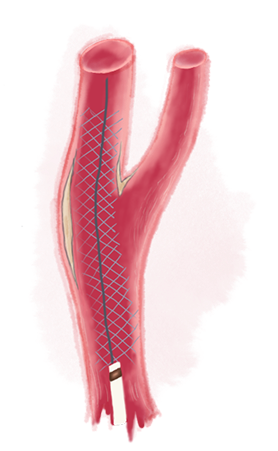
Angioplasty with stent placement is performed at the site of the arterial narrowing in order to restore normal blood flow. First, the physician gains access to the vascular system—usually through the wrist or groin—and guides a thin catheter to the area of the blockage. With the help of imaging guidance , the narrowed segment is identified. A small balloon is then used to open the artery by compressing the atherosclerotic plaque against the vessel wall.
At the same site, a stent is placed. A stent is a small metal mesh tube that remains permanently inside the artery and acts as a support, helping keep the vessel open and maintain smooth blood flow. After the procedure is completed, the catheter is removed and the patient is monitored for a short period before returning to normal activities.
Difference Between Angioplasty and Stent
Although the two terms are often used together, they do not mean the same thing. Angioplasty refers to the procedure itself, in which a physician opens a narrowed artery to restore blood circulation. A stent, on the other hand, is the small metal support placed inside the artery to keep it open and preserve the result of the procedure.
In simple terms, angioplasty is the treatment method, while the stent is the internal support that helps maintain blood flow over time.
Life After Angioplasty
Most patients notice immediate improvement in their symptoms, as chest pain becomes less frequent or disappears, difficulty walking improves, and breathing may become easier.
Recovery is usually short, and patients return quickly to daily activities. Most importantly, the procedure reduces the risk of major complications such as heart attack and stroke, providing greater safety and confidence for the future.
However, the long-term success of angioplasty depends not only on the procedure itself, but also on what follows. The result is best maintained with correct medical treatment, healthy dietary habits, regular physical activity, and control of cardiovascular risk factors. These measures help preserve the benefit of the intervention and improve quality of life in the long term.
Frequently Asked Questions (FAQs)
How many years do stents last?
Stents are designed to remain permanently inside the artery. In most cases, they function well for many years, especially when the patient follows medical advice and prescribed medication correctly.
I have pain after a stent - is that normal?
Mild discomfort or a feeling of pressure at the access site is common during the first few days. However, if severe or persistent pain develops, the patient should contact the doctor immediately.
What should I be careful about after stent placement?
After angioplasty, it is important to take all prescribed medications, avoid smoking, follow a balanced diet, and attend regular medical follow-up appointments. These measures help maintain the long-term success of the treatment.
How long does recovery after stent placement take?
Recovery is usually rapid, and most patients return to their usual daily activities within a few days. The exact recovery time may vary depending on the patient’s overall health.
Can I walk after angioplasty with stent placement?
Yes. Walking is usually allowed soon after the procedure and is often considered beneficial. Your doctor will always provide individualized instructions about when and to what extent physical activity can begin.
How much does angioplasty with stent placement cost?
The cost may vary significantly depending on: the type of stent used the severity and complexity of the disease the hospital setting For an accurate estimate, a personalized medical evaluation is necessary.

