


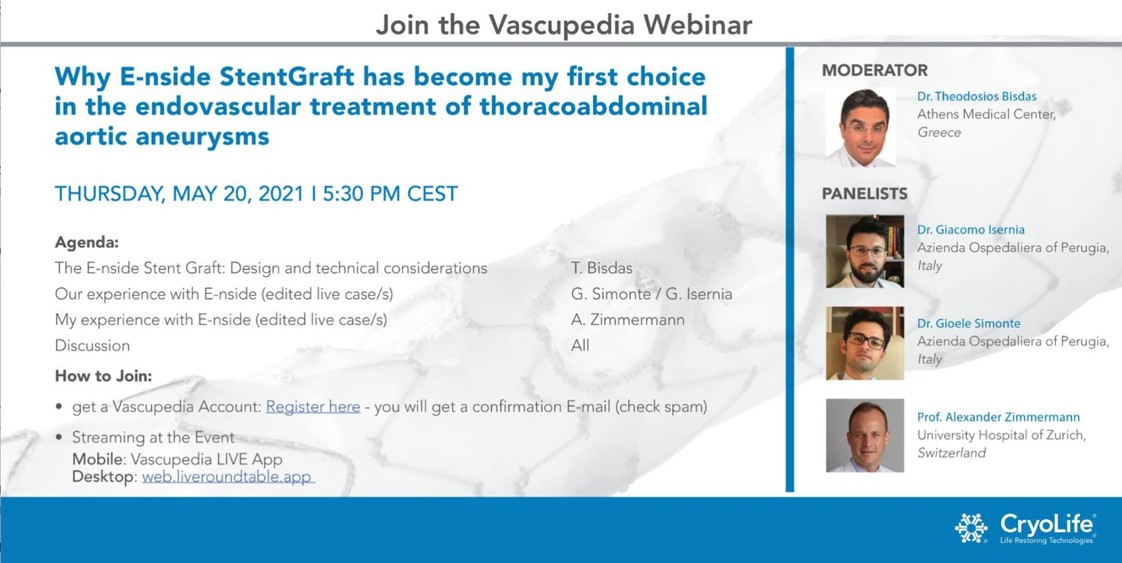
Vascupedia 2021, online webinar – Lecture on the use of a stent graft with visceral branches for the minimally invasive treatment of complex thoracoabdominal aneurysms.
What is a branched endograft with visceral branches?
In the Vascupedia 2021 online webinar, the talk concerned the use of the endograft with visceral branches for the minimally invasive treatment of complex thoracoabdominal aneurysms.
The endografts come in different types, depending on the size and shape of the aneurysm, and the choice is made individually for each patient.
What does "with visceral branches" mean?
The endograft carries built-in branches corresponding to the arteries towards the liver, the intestine, the spleen and the kidneys. The aneurysm is therefore isolated from the circulation, while the blood supply of the organs is preserved. Conventional straight endografts cannot be used in this position.
How is the procedure planned?
Each patient has a different anatomy, so the position and the number of branches are determined by CT angiography. The planning is done before the procedure and the endograft is often manufactured to order for the specific patient.
What is the benefit for the patient?
Open repair of a thoracoabdominal aneurysm is among the heaviest procedures in vascular surgery. The endovascular alternative limits the surgical trauma, reduces blood loss and shortens the hospital stay to a few days. For high-risk patients it is often the only option.
What is Vascupedia?
An international online platform for vascular surgery education, where techniques and cases are presented in webinars with open participation. See in detail the EVAR endografts.
When is a procedure needed?
According to the ESVS guidelines, repair is considered when the diameter reaches 5.5 centimetres in men and 5 centimetres in women, or when the growth exceeds 1 centimetre per year. An aneurysm rarely gives symptoms and is often diagnosed incidentally.
What follows afterwards?
Lifelong imaging follow-up with CT angiography is required, so that it can be confirmed that the endograft remains in place and that there is no leakage around it. See the comparison of endovascular and open repair.