


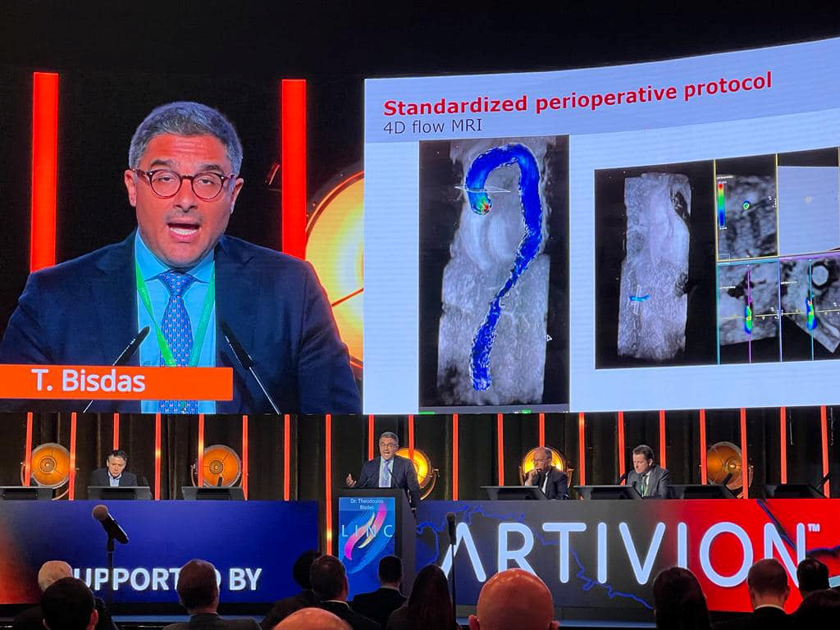
LINC 2024, Leipzig, Germany – Lecture on endovascular treatment of complex aortic aneurysms and peripheral arterial disease.
What was presented at LINC 2024 on aortic aneurysms?
At LINC 2024 in Leipzig, Germany, the talk concerned the endovascular treatment of complex aortic aneurysms and peripheral arterial disease.
In peripheral arterial disease blood flow to the arms and legs is reduced because of narrowing of the arteries, while the abdominal aortic aneurysm grows silently, with a risk of rupture.
What are complex aortic aneurysms?
Complex aneurysms are those involving segments of the aorta from which vital vessels arise, such as the renal or the visceral arteries. Their repair requires special endografts with fenestrations or branches, so that flow to the organs is preserved.
Why is it linked to peripheral arterial disease?
Both conditions share atherosclerosis as their common background. In peripheral arterial disease the narrowing of the arteries of the lower limbs causes pain on walking, while in an aneurysm the wall of the aorta weakens and dilates.
When does an aneurysm require surgery?
According to the ESVS guidelines, repair of an abdominal aortic aneurysm is considered when the diameter reaches 5.5 centimetres in men and 5 centimetres in women, or when the growth exceeds 1 centimetre per year. An aneurysm rarely causes symptoms and is often diagnosed incidentally during tests for another reason.
How does peripheral arterial disease present?
The classic symptom is intermittent claudication: pain or cramp in the calf that appears while walking and subsides with rest. The diagnosis is documented with the ankle-brachial index, where a value below 0.9 establishes the diagnosis.
Atherosclerosis progresses silently for years, without obvious symptoms, until the narrowing becomes significant. This is why timely vascular assessment matters in patients with risk factors such as smoking, diabetes mellitus, hypertension and high cholesterol. See in detail the risk factors for vascular disease are.