


The first use in Greece of the Phoenix atherectomy catheter (atherectomy device, Philips) in a patient with peripheral arterial disease.
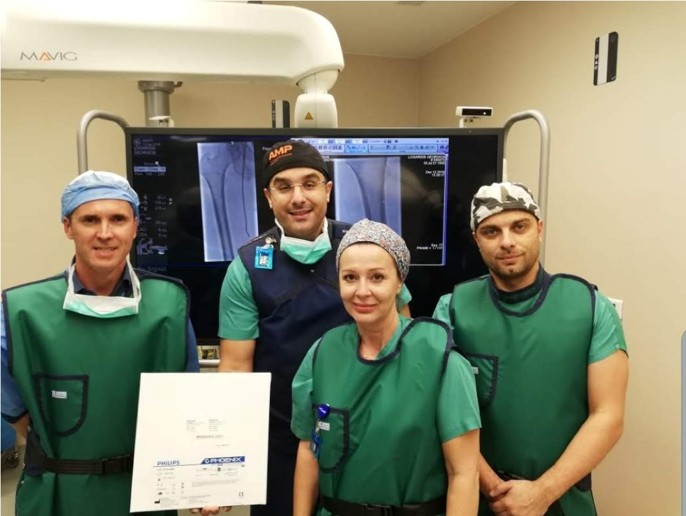
What was the first use in Greece of the Phoenix atherectomy catheter?
First use in Greece of the Phoenix endovascular atherosclerotic plaque removal catheter (atherectomy device, Philips), in a patient with peripheral arterial disease. The procedure was performed in the Hybrid operating room of the Athens Medical Center.
The atherosclerotic plaque is an accumulation of cholesterol, lipids, calcium and inflammatory cells in the inner wall of the arteries, which narrows the lumen of the vessel. The catheter removes it endoluminally.
Τι είναι η αθηρεκτομή;
Είναι η στοχευμένη αφαίρεση της atherosclerotic plaque from inside the artery, through a special catheter introduced by puncture. Unlike angioplasty, which simply opens the vessel by pressing the plaque against the walls, atherectomy removes the obstruction.
When is it preferred over a stent?
In the arteries of the lower limbs the main drawback of a stent is restenosis, while in the region of the knee there is also a risk of fracture from the movement of the joint. Atherectomy allows flow to be restored without implanting a metal mesh, where that is preferable.
Which patients is it used in?
Mainly in patients with peripheral arterial disease, particularly when the lesions are extensive or heavily calcified. It is also used in restenosis after a previous angioplasty. All catheters are combined with protective filters that capture any fragments.
What is recovery like?
The procedure is minimally invasive and is performed under local anaesthesia. The patient is awake, feels no pain and usually returns home the same or the next day. See in detail the page on Endovascular Surgery.
What types of catheter are there?
There are different types depending on the removal method: directional devices that cut and remove the plaque, rotational, orbital and laser. The choice is made individually by the vascular surgeon, according to the type, location and extent of the lesion. See in detail the page on atherosclerotic plaque.
Atherosclerotic plaque is an accumulation of cholesterol, lipids, calcium and inflammatory cells in the inner wall of the arteries. It develops silently over years, without obvious symptoms, until the narrowing becomes significant. See the risk factors.